Seven years ago, Help a Child started a Child Centered Community Development CCCD programme in Arivu, Arua District, Uganda. The programme has now come to an end, and the impact we were able to achieve is impressive.
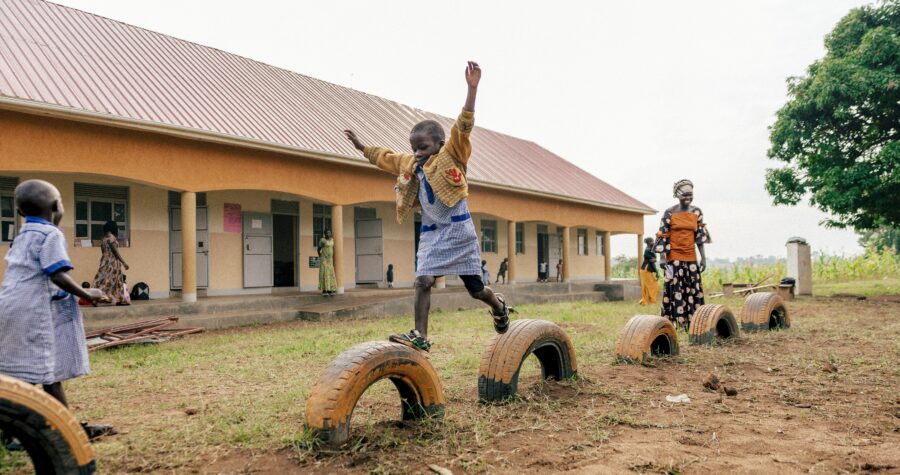 Together with African Evangelistic Enterprise (AEE), we facilitated a good start for young children aged 0 -6 years, we improved community empowerment and participation by setting up Self-Help Groups (SHGs) and Cluster Level Association (CLAs), and we supported women, youth and farmers in earning sustainable incomes for their households.
All activities were implemented to advance child well-being, community empowerment, sustainable livelihoods, and improved education in Arivu sub-county.
Programme interventions also led to improvements in home and child safety. Families reported safer living environments, reduced incidents of domestic violence and enhanced child protection.
The community is now ready and able to continue building its future independently.
To read more on the highlights of achievements and stories that show the real impact, read this report. Or watch this beautiful video below and join us in celebrating this special milestone.
A better tomorrow for the children of today. That’s our driving force for almost 60 years. And despite the many challenges we faced in 2025, we were able to support 496,253 children in taking steps towards a better future by providing protection and education, particularly for the youngest children.
 Through our Early Childhood Development programmes, ECD centres, parenting support, Early learning activities, and Child Protection programmes, we create nurturing environments where young children can truly thrive. At the heart of our work is a belief in empowering families to become self-reliant, sustainably, even in the face of crisis.
Highlights of 2025:
- We were able to support 496,253 children;
- Our income reached €26,113,000, and we spent 93,4% on objectives;
- In terms of funding, we had a good year in 2025;
- 2025 was the first year of the implementation of our innovative five-year Turakura programme in Rwanda and the introduction of the accompanying Turakura funding model in the Netherlands;
- We introduced PIPPA, a combination of Parenting and climate-resilient farming;
- We launched our first outcomes-based financed project with EOF in Rwanda;
- We sold 828,490 products through our charity shops in The Netherlands.
However, our work is not just about numbers and programmes. It is about the personal stories of the vulnerable children and their families we work with. Our Impact Report tells their stories:
[button_primary link=”https://www.helpachild.org/wp-content/uploads/2026/04/Impact-Report-2025.pdf” target=”_self”]Impact Report 2025[/button_primary]
Also in 2025, we introduced innovative approaches that help accelerate the impact of our work. In Rwanda, for example, we launched a new five-year programme called Turakura Kids Rwanda, replacing individual sponsorship with a community-based funding model. The programme focuses on children in ECD centres, supporting their parents by providing parenting training and teaching improved agricultural techniques. We introduced PIPPA (Parenting and climate-resilient farming) and launched our first outcomes-based financed project with EOF.
Join us and explore the impact we’ve made in the lives of almost half a million children in countries in Africa and India by watching this short video:
And just as we have for almost 60 years, we are determined to continue to create a life full of opportunities for children in need. However, we cannot do this without your support. Every contribution, partnership, and effort has played a meaningful role in making this possible. Thank you for being such an essential part of our mission!

The future of a nation is shaped long before a child enters a classroom. From conception to age eight, early experiences in health, nutrition, protection, and play determine whether children arrive at school ready to learn or already left behind. That’s why Help a Child focuses on the young child.
On the 28th January 2026, a new Early Childhood Development (ECD) Center was launched in Nyakiga (Butaganzwa Commune, Buhumuza Province) through the Child Centered Community Development (CCCD) programme implemented by FECABU with the technical and financial support from Help a Child. The event brought together representatives from the Ministries of Education, Human Rights and Health, the Provincial Administration, and OAFLAD/OPDAD, reflecting a shared, multisectoral commitment to young children.
 The centre offers high-quality preschool education for children aged 3–5, inclusive play spaces, safe and accessible sanitation facilities, and parental awareness sessions on child protection, health, nutrition, hygiene, and nurturing care. These services are delivered in partnership with decentralised Burundian government services.
As Grâce Nininahazwe, ECD and Child Protection Advisor at Help a Child, highlighted: “This center will support children and parents, especially pregnant and breastfeeding women through health, nutrition, protection, and education tailored to children’s developmental needs.”
Echoing this, Malysie Hatungimana, Director of Preschool and ECD at the Ministry of Education, added: “Children learn through games and songs. Play develops language, social skills, and respect for rules, while helping detect early learning challenges and reducing school dropout rates.”
 In turn, Fulgence Ndagijimana, Country Director of Help a Child Burundi, encouraged students of all levels from preschool onwards to continue their education to prepare for a better future. He further emphasised that the Nyakiga ECD Center demonstrates how community-anchored, multisectoral approaches can simultaneously protect, nurture, and educate children. This aligns with Burundi’s National ECD Strategy (2021–2027) and global commitments under SDG 3 (Good Health & Well-Being) and SDG 4.2 (Early Childhood Education), showing that investing early is not just ethical, it’s strategic.
In conclusion, Richard Butoke, Head of School Administrative Action at the Ministry of National Education and Scientific Research, stated: “This space is not just a building; it is the symbol of a collective commitment to the future of our children.”
By bringing together families, communities, and government services, the center is more than infrastructure, it is a foundation for resilient, thriving children and a stronger society.